
Understanding Adhesive Hooks for Curtains
Adhesive hooks for curtains let you hang curtain rods without drilling a single hole. Here’s what you need to know at a glance:
- How they work: Peel-and-stick polymer strips bond to your wall and support a hook or bracket that holds a curtain rod
- Weight capacity: Most hold between 5 and 20 lbs depending on the product
- Best surfaces: Painted drywall, smooth tile, glass, and finished wood
- Installation time: As little as 5 minutes
- Renter-friendly: Remove cleanly without holes, marks, or sticky residue
If you’ve ever tried to hang curtains in a rental and dreaded the thought of losing your security deposit, you’re not alone. Drilling into walls is messy, permanent, and often not allowed. But bare windows aren’t the answer either.
The good news? Adhesive curtain hooks have come a long way. Products from brands like Command and no-drill bracket systems now hold up to 20 lbs — enough for most everyday curtain panels — with zero tools required.
This guide walks you through everything: how these hooks work, which surfaces they stick to, how to install them properly, and how to remove them without a trace.
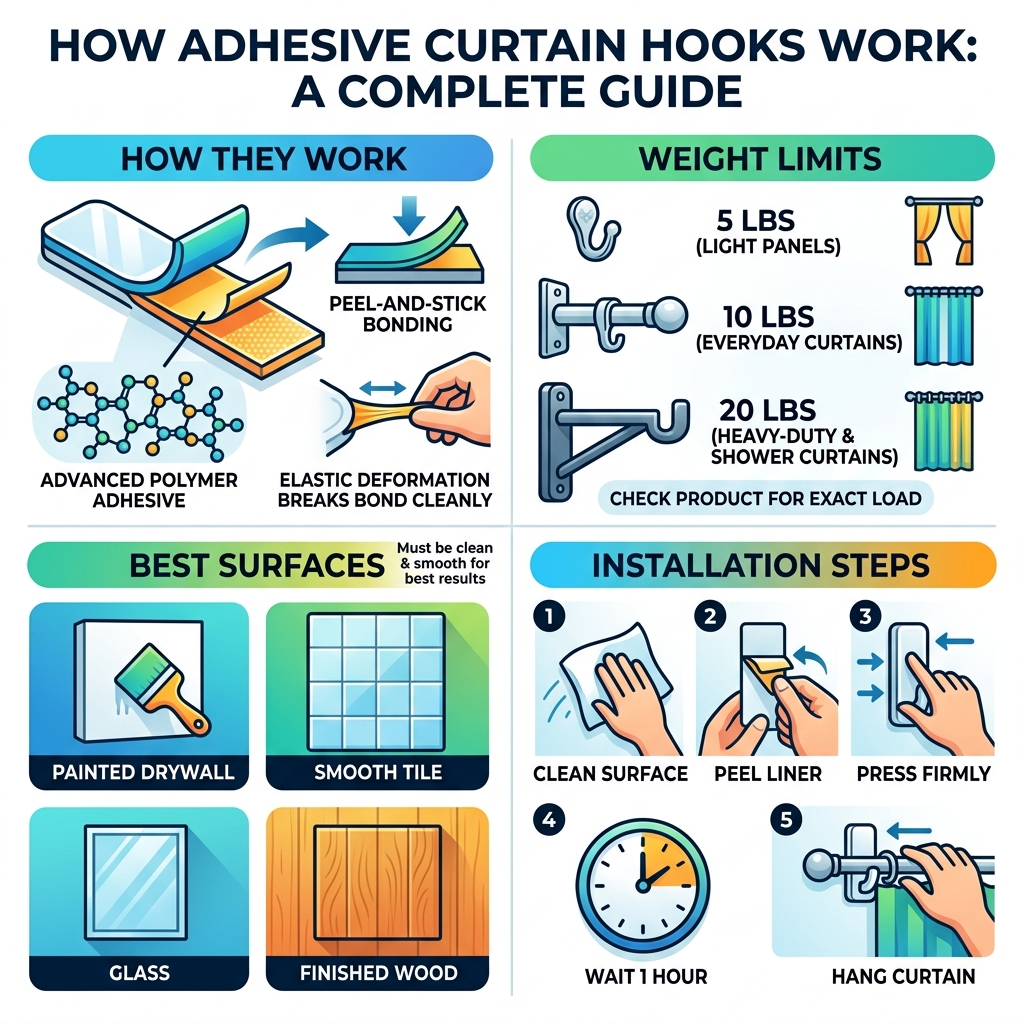
At their core, these clever devices rely on advanced adhesive technology. Most modern adhesive hooks for curtains use stretch-release polymer strips. These strips create a powerful vacuum-like bond with the surface they are pressed against. Unlike traditional glue, which can become brittle or permanent, these strips are designed to be “elastically deformed.” When you pull the tab at the bottom, the strip stretches, breaking the adhesive bond cleanly without taking the paint or drywall with it.
For those of us looking for Practical Wall Storage Ideas That Don’t Require Drilling, these hooks are a total game-changer. They transform the way we think about window treatments, moving them from a “permanent renovation” category to a “flexible decor” category. Whether you are using a sleek metallic hook for a living room rod or a heavy-duty transparent bracket for a shower curtain, the mechanics remain the same: high-strength tension without the power tools.
Weight Capacity of Adhesive Hooks for Curtains
One of the most common questions we hear is: “Will my curtains actually stay up?” The answer depends entirely on the weight capacity of the specific hook you choose. Not all adhesive hooks for curtains are created equal.
- Light Duty (1-5 lbs): These are typically standard utility hooks. They are perfect for sheer curtains, cafe curtains, or lightweight polyester shower curtains. For example, a standard large utility hook often supports around 5 lbs.
- Medium Duty (5-10 lbs): Specialized curtain rod hooks, such as those from the Command brand, are often rated for 10 lbs per pair. These can easily handle standard cotton or linen panels.
- Heavy Duty (10-20 lbs): Some advanced adhesive brackets, often sold in multi-packs, claim a holding capacity of up to 20 lbs per pair. These are the “heavy lifters” of the no-drill world, suitable for blackout curtains or heavier velvet drapes.
To ensure your curtains don’t come crashing down in the middle of the night, we always recommend weighing your curtain rod and fabric together. Also, pay attention to the rod diameter. Most adhesive hooks are designed to fit rods between 0.5 inches and 1.2 inches. If your rod is too thick, it won’t sit securely in the hook’s cradle, which shifts the center of gravity and can cause the adhesive to fail prematurely.
Best Surfaces for Adhesive Hooks for Curtains
For the adhesive to work its magic, the surface needs to be “friendly.” Adhesives love smooth, non-porous surfaces because they allow for maximum contact area.
- Painted Drywall: This is the most common surface. As long as the paint is fully cured (usually 30 days after painting) and not peeling, the hooks will hold beautifully.
- Smooth Tile: Ideal for bathrooms. Adhesive hooks bond incredibly well to ceramic and porcelain tiles.
- Glass and Mirrors: If you want to hang a curtain over a glass door or a sidelight window, adhesive hooks are your best friend.
- Finished Wood: Smooth, varnished window frames are excellent candidates for these hooks.
However, we should mention that highly textured walls (like popcorn walls or heavy orange-peel textures) are the natural enemies of adhesive strips. The “peaks and valleys” of the texture prevent the strip from making full contact, which significantly reduces the weight capacity. For more tips on making the most of your space, check out our Creative Decorating Tips for Small Apartments.
Benefits of No-Drill Curtain Hardware
Why choose adhesive over the traditional hammer and nail? Aside from the obvious “I don’t want to get evicted” reason, there are several practical benefits to going the no-drill route.
| Feature | Adhesive Hooks | Traditional Brackets |
|---|---|---|
| Installation Time | 5–10 Minutes | 30–60 Minutes |
| Tools Needed | None (maybe a level) | Drill, Screws, Anchors, Hammer |
| Skill Level | Beginner | Intermediate |
| Wall Damage | Zero (when removed correctly) | Holes, Dust, and Scratches |
| Flexibility | Easy to move and adjust | Permanent placement |
| Renter Friendly | 100% | Often requires permission/repair |
The flexibility factor is huge. If you realize your curtain rod is an inch too low, with an adhesive hook, you simply pull the tab and reposition it. With a drill, you’re looking at patching a hole, sanding, and repainting. This makes adhesive solutions one of the best Tiny Apartment Hacks: How to Organize and Maximize Your Space, allowing you to experiment with height and style without the “commitment issues” of permanent hardware.
Furthermore, adhesive hooks are incredibly discreet. Many modern versions come in finishes like brushed nickel, oil-rubbed bronze, or even completely transparent plastic. This allows them to blend into your decor rather than standing out like a sore thumb.
Step-by-Step Installation for a Secure Hold
Installing adhesive hooks for curtains is easy, but it isn’t “slap it on and walk away.” To get that 20 lb weight capacity, you need to follow a specific process. Most failures happen because of skipped steps during prep.
1. Clean the Surface
This is the most important step. Dust, oils from your fingers, and microscopic grime will prevent the adhesive from bonding. Use a clean cloth and isopropyl rubbing alcohol to wipe down the exact spot where the hook will go. Avoid using household “multi-surface” cleaners, as many leave behind a slippery residue that is the ultimate enemy of adhesive.
2. Mark Your Spot
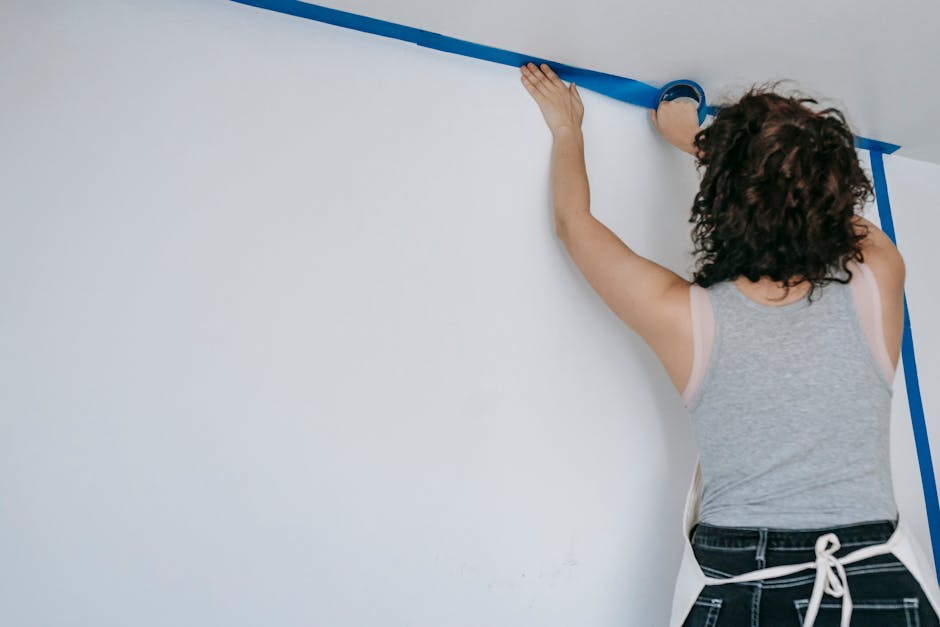
Don’t eyeball it! Use a pencil or a small piece of painter’s tape to mark exactly where the hooks will sit. Use a level to ensure your rod will be straight. Once the adhesive touches the wall, you really only have one shot to get the placement right.
3. Apply the Strip to the Hook
Peel the liner off the “hook side” of the adhesive strip and press it firmly onto the back of the bracket or hook. Many brands recommend pressing along the entire length of the strip for 30 seconds to activate the pressure-sensitive adhesive.
4. Press the Hook to the Wall
Peel the remaining liner and press the hook onto your marked spot on the wall. Again, use firm pressure. Don’t just tap it; really lean into it for about 30 seconds.
5. The “Wait” Rule (Crucial!)
Here is where most people go wrong: they hang the curtains immediately. Do not do this. Most adhesive strips need time to “cure” and form a permanent bond. We recommend waiting at least 1 hour, though waiting 24 hours is the gold standard for heavy curtains. This patience ensures that the chemical bond is fully set before it has to fight gravity.
6. Hang Your Rod and Curtains
Once the waiting period is over, slide your curtains onto the rod and gently place the rod into the hooks. Distribute the weight evenly so that one hook isn’t doing all the work. For more DIY inspiration, see our guide on DIY Storage Ideas: Make the Most Out of Your Small Apartment.
Limitations and Removal Without Wall Damage
While we love adhesive hooks for curtains, they aren’t magic. There are a few scenarios where they might struggle.
- Humidity: In a very steamy bathroom, standard adhesive strips can lose their grip. If you are hanging a shower curtain, look for “water-resistant” or “bath” specific strips. These are designed to withstand the heat and moisture of a daily shower.
- Wallpaper: Never use adhesive strips on wallpaper. The bond between the strip and the wallpaper is often stronger than the bond between the wallpaper and the wall. You will likely peel the paper right off.
- Fresh Paint: Wait at least 28 to 30 days before applying adhesive to a newly painted wall. Paint needs time to fully outgas and harden.
How to Remove Without Damage
When it’s time to move or change your style, removal is simple—if you do it right.
- Remove the Rod: Take down the curtains and rod first.
- Hold the Hook: Gently hold the plastic hook in place (don’t press it into the wall, just stabilize it).
- The Slow Pull: Grab the exposed tab at the bottom of the strip. Slowly pull the tab straight down toward the floor. Do not pull it toward you or at an angle.
- Keep Going: The strip will stretch… and stretch… and stretch. It might stretch up to 12 inches before it finally releases.
- Heat (Optional): If the strip feels stuck or brittle (common in older installations), use a hair dryer on a low setting to gently warm the adhesive for 30 seconds. This softens the polymer and makes the pull much smoother.
By following these steps, you ensure you leave the wall exactly as you found it, making this one of the most Affordable Storage Solutions for Renters.
Frequently Asked Questions about No-Drill Rod Holders
Can adhesive hooks be used in high-humidity bathrooms?
Yes, but you must use the right product! Standard adhesive strips can fail when exposed to constant steam. Look for “Bath” versions of adhesive hooks or “Water-Resistant” strips. These are formulated with a different chemical base that doesn’t break down when it gets wet. Also, make sure the tile is bone-dry when you first install them.
What curtain rod sizes are compatible with adhesive brackets?
Most adhesive hooks for curtains are designed for standard rods.
- Small Hooks: Usually fit rods up to 0.5 inches in diameter (great for sheers).
- Standard Curtain Hooks: Designed for 0.5 to 0.75-inch rods.
- Heavy-Duty Brackets: Often adjustable or designed with larger cradles that can accommodate rods up to 1.2 inches in diameter. Always check the packaging to ensure your rod isn’t too “chunky” for the hook.
How do I prevent adhesive hooks from falling over time?
The secret to longevity is weight distribution and surface prep.
- Don’t Max Out the Weight: If a hook says it holds 10 lbs, try to stay around 7 or 8 lbs.
- Center Support: For windows wider than 48 inches, use a third hook in the center of the rod. This prevents the rod from bowing and reduces the leverage pull on the side hooks.
- Avoid Touching the Adhesive: When installing, try not to touch the sticky part of the strip with your fingers, as the oils from your skin can weaken the bond.
Conclusion
At Gostosuras Doces, we believe that your home should reflect your personal style, whether you own it or are just visiting for a while. Adhesive hooks for curtains are a brilliant, budget-friendly way to add privacy, block light, and bring a touch of elegance to any room without the stress of permanent hardware.
By choosing the right weight capacity, prepping your surfaces with care, and giving the adhesive time to cure, you can enjoy beautiful window treatments that stay secure for years. And when you’re ready for a change? They’ll disappear as if they were never there.
Ready to tackle more home improvement projects without the power tools? Explore more small space ideas on our blog and discover how easy it is to transform your space!
