
Why Adhesive for Wall Mounting Is a Game-Changer for Renters and Homeowners
Adhesive for wall mounting lets you hang decor, frames, and organizers without drilling a single hole — no tools, no damage, no landlord stress.
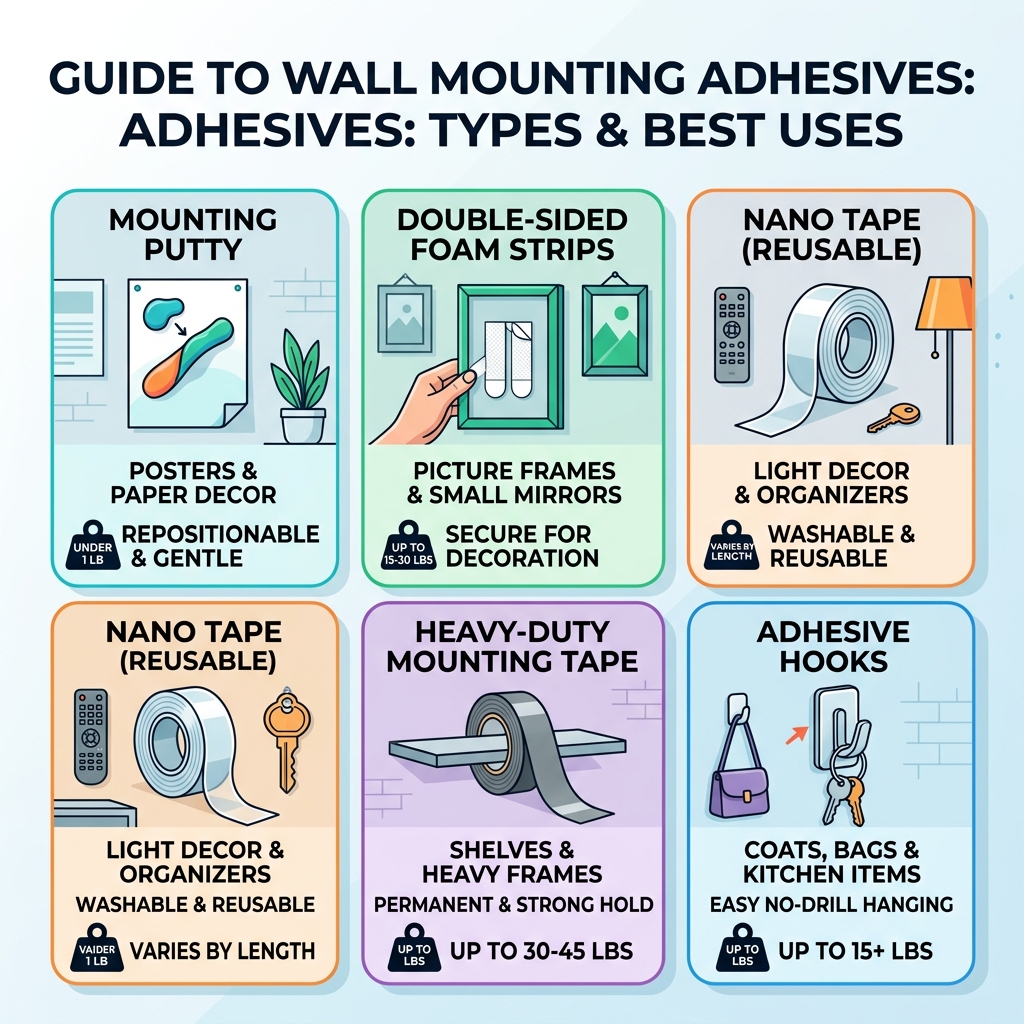
Here’s a quick look at the most common types and what they’re best for:
| Adhesive Type | Best For | Typical Weight Limit |
|---|---|---|
| Mounting putty | Posters, lightweight paper decor | Under 1 lb |
| Double-sided foam strips | Picture frames, small mirrors | Up to 15–30 lbs |
| Nano tape (reusable) | Light decor, repositionable items | Varies by length |
| Heavy-duty mounting tape | Shelves, heavy frames | Up to 30–45 lbs |
| Adhesive hooks | Coats, bags, kitchen items | Up to 15+ lbs |
Most people reach for a drill out of habit. But modern wall adhesives have come a long way — some industrial-strength tapes can now hold up to 45 pounds on a painted wall.
That said, not every adhesive works on every surface. And removal is where things can go wrong fast. Even products marketed as “damage-free” can peel paint if applied incorrectly or pulled off too quickly.
If you’ve ever had something crash off the wall at 2am, you’re not alone. The good news? The right adhesive — used the right way — can hold reliably for months or even years.
This guide covers everything: which adhesive to pick, how much you need, which surfaces to avoid, and how to remove it cleanly when the time comes.
Essential Types of Adhesive for Wall Mounting
When we talk about hanging things without a drill, we aren’t just talking about one-size-fits-all tape. The world of adhesive for wall mounting is surprisingly diverse. Choosing the wrong one is usually why items end up on the floor in the middle of the night.
To get started, we need to understand the “Big Four” of no-damage adhesives: nano tapes, foam strips, mounting putties, and adhesive dots. Each has a specific chemistry designed for different weights and surfaces. For instance, if you are looking for practical wall storage ideas that don’t require drilling, you’ll likely need a combination of these to handle everything from spice racks to heavy mirrors.
Reusable Nano Tape vs. Disposable Strips
One of the newest players in the game is Nano Tape (often called Alien Tape or Gecko Tape). This is a clear, gel-based adhesive that uses microscopic suction cups (inspired by gecko feet!) to grip surfaces.
- Nano Tape Pros: It is often washable and reusable. If the adhesive gets dusty and loses its “stick,” you can literally rinse it under cold water, let it air dry, and it’s ready to go again. It is incredibly cost-effective because one roll can last through multiple room re-decorations.
- Nano Tape Cons: It can be too strong on certain paints. If you don’t remove it correctly, it can take a chunk of drywall with it.
- Disposable Strips (like Command): These are the gold standard for renters. They use a “stretch-release” technology. Instead of peeling them off like a band-aid, you pull a tab to stretch the adhesive, which causes the bond to release cleanly without leaving any residue. They are single-use, but they are the safest bet for painted walls.
Heavy-Duty Adhesive for Wall Mounting
For the big stuff—think heavy wooden frames or even small floating shelves—you need industrial-strength mounting tape. Products like Scotch-Mount Extreme or Gorilla Max Strength are designed for permanent or semi-permanent bonds.
These typically feature a thick foam backing. This foam isn’t just for cushion; it allows the adhesive to “conform” to the texture of the wall. If your wall isn’t perfectly flat (and let’s be honest, few are), the foam fills in the gaps to ensure 100% contact. While these are the strongest holds: the best adhesive hooks heavy duty buyers love, keep in mind that “heavy-duty” often means “permanent.” If you use a tape rated for 45 lbs, expect it to be a challenge to remove later.
Choosing the Right Strength for Your Decor
Weight capacity is the most critical statistic you’ll encounter. On Amazon, you’ll see products with over 117,000 reviews, like Command Large Picture Hanging Strips, which have a 4.6-star rating for a reason: they tell you exactly how much they hold.
Before you stick anything, weigh your decor on a kitchen scale. Guessing is the fastest way to a broken frame. Once you have the weight, check out our guide on how to hang your masterpiece: top adhesive picture hangers to match the product to the poundage.
Lightweight Solutions for Posters and Photos
For paper-thin items, heavy tapes are overkill and can actually ruin your art. Instead, look for:
- Mounting Putty: Think of this as the “blue tack” of your school days, but better. Modern putties, like Gorilla Mounting Putty, are non-toxic and repositionable. They are perfect for posters because they don’t leave oily stains on the paper.
- Sticky Dots: These are tiny, pre-cut circles of clear adhesive. They are excellent for creating photo collages or hanging lightweight “fairy lights” where you want the adhesive to be invisible.
- Poster Strips: These are thinner versions of picture hanging strips. They are specifically designed to hold up to 1 lb without tearing the corners of your favorite prints.
Maximum Capacity for Heavy Frames and Shelves
When you move into the “Heavyweight” category (items over 5 lbs), the rules change. You can’t just use one strip and hope for the best. You have to distribute the weight.
- Weight-to-Length Ratios: Most heavy-duty tapes, like Scotch-FIX Double-Sided Interior Mounting Tape, use a formula. For example, you might need 22cm of tape to hold 1kg (or about 3 inches of tape per pound).
- Depth Restrictions: This is a pro tip many people miss. Most adhesive for wall mounting ratings are based on objects no deeper than 0.75 inches. If you try to hang a deep shadow box or a shelf that sticks out 6 inches from the wall, the “leverage” or center of gravity pulls away from the wall, making the adhesive fail much faster than the weight rating suggests.
- The 30lb Limit: While some tapes claim 45 lbs, most experts recommend staying under 30 lbs for safety. If you are pushing the limits, read our guide on how to stop the drop: a guide to adhesive wall hooks for heavy items.
Surface Compatibility: Where to Stick and What to Avoid
You could have the strongest glue in the world, but if the surface it’s sticking to is flaky or dirty, it will fail. Adhesion is a two-way street.
If you’re dealing with tricky surfaces like masonry, you’ll want to check out our specific tips for brick wall adhesive hooks: our top heavy-duty picks.
Best Surfaces for Long-Term Adhesion
Adhesives love “high-energy” surfaces. These are materials that allow the glue to flow and grip easily.
- Painted Drywall: The most common surface. As long as the paint is fully cured (waited at least 30 days after painting), it’s a great candidate.
- Metal and Glass: These are non-porous and smooth. Tapes like Scotch-Mount Indoor Double-Sided Mounting Tape bond almost instantly to these.
- Finished Wood: Smooth, varnished wood works well. Unfinished, “raw” wood is too porous and will soak up the adhesive, leading to a weak bond.
- Tile and Acrylic: Perfect for bathrooms or kitchens, provided you use a moisture-resistant version.
High-Risk Surfaces That May Suffer Damage
Avoid these surfaces unless you are okay with a permanent bond or potential repair work:
- Wallpaper: Never use “damage-free” strips on wallpaper. The adhesive is often stronger than the wallpaper’s bond to the wall. When you pull the strip, the wallpaper comes with it.
- Textured Plaster/Popcorn Walls: The adhesive can only touch the “peaks” of the texture, leaving the “valleys” empty. This reduces your contact area by up to 50%, meaning your 10lb-rated strip might only hold 5 lbs.
- Fresh Paint: Paint feels dry to the touch in hours, but it takes weeks to “cure” (harden completely). Applying adhesive too soon traps moisture and will peel the paint when removed.
- Brick and Stone: These are porous and often dusty. Unless you use a specialized product like Gorilla Max Strength Mounting Tape, they usually won’t hold for long.
How to Apply and Remove Adhesive for Wall Mounting Safely
Success with adhesive for wall mounting is 10% product and 90% technique. We’ve seen the best products fail because someone skipped the cleaning step.
Professional Application Tips for Longevity
- The Alcohol Wipe: This is non-negotiable. Use 70% isopropyl alcohol to clean the area. Do not use household cleaners or Windex; these often leave a “slippery” residue that prevents the adhesive from bonding.
- The 60-Second Rule: Most pressure-sensitive adhesives require… well, pressure! After sticking the item, press firmly for at least 60 seconds. This helps the adhesive “wet out” into the microscopic pores of the wall.
- Check the Temperature: Most adhesives, including Scotch-Mount Extreme Double-Sided Mounting Tape, require an application temperature between 50°F and 100°F. If you try to mount something in a freezing garage, the glue will stay “glassy” and won’t stick.
- Vertical Alignment: Always apply tape strips vertically on the back of your object. This helps distribute the weight evenly with gravity.
Removing Adhesive for Wall Mounting Without Damage
When it’s time to move out, don’t just rip it off.
- The Stretch Method: For Command-style strips, pull the tab straight down, hugging the wall. You may need to stretch it up to 12 inches before it releases. Never pull it toward you (away from the wall).
- The Dental Floss Trick: For stubborn foam tapes like Scotch Extremely Strong Mounting Tape, take a piece of dental floss or fishing line. Saw it back and forth behind the object to cut through the foam core. Once the object is off, you can gently peel the remaining “skin” of adhesive or use a citrus-based dissolver.
- Heat it Up: A hairdryer on a low setting can soften the adhesive, making it much easier to peel without snapping the plastic or tearing the paint.
Frequently Asked Questions about Wall Adhesives
Can I use mounting tape on freshly painted walls?
We recommend waiting at least 28 to 30 days. Even if the paint feels dry, it is still “off-gassing.” If you seal it with tape, the gas gets trapped, creates a bubble, and ensures that when you remove the tape, the paint will come off with it.
How do I calculate how much tape I need for a heavy mirror?
Check the packaging for the “weight-to-length” ratio. For example, if a tape like Scotch-Mount Indoor Double-Sided Mounting Tape says “3 inches holds 1 lb,” and your mirror weighs 10 lbs, you need 30 inches of tape. We recommend putting 15 inches on the left side and 15 inches on the right side for balance.
Will humidity cause my adhesive hooks to fail in the bathroom?
Standard adhesives often fail in high humidity because moisture gets between the wall and the glue. Always look for “Water-Resistant” or “Bathroom” specific strips. These use a different type of adhesive (usually a silicone-based or modified acrylic) that won’t lose its grip when you take a hot shower.
Conclusion
Living in a rental or a new home doesn’t mean you have to stare at blank white walls. By choosing the right adhesive for wall mounting, you can create a space that feels like yours without worrying about a repair bill later.
Whether you’re using lightweight putty for a photo wall or industrial-strength tape for a gallery of frames, remember the golden rules: clean with alcohol, apply pressure, and never rush the removal.
Ready to transform your home? Explore our full range of storage solutions at Gostosuras Doces for more inspiration on organizing your space—damage-free!
