
Why Every Renter Needs a Picture Hanger Without Nails
A picture hanger without nails is exactly what it sounds like — a way to display your art, photos, and decor on walls without drilling, hammering, or leaving permanent damage behind.
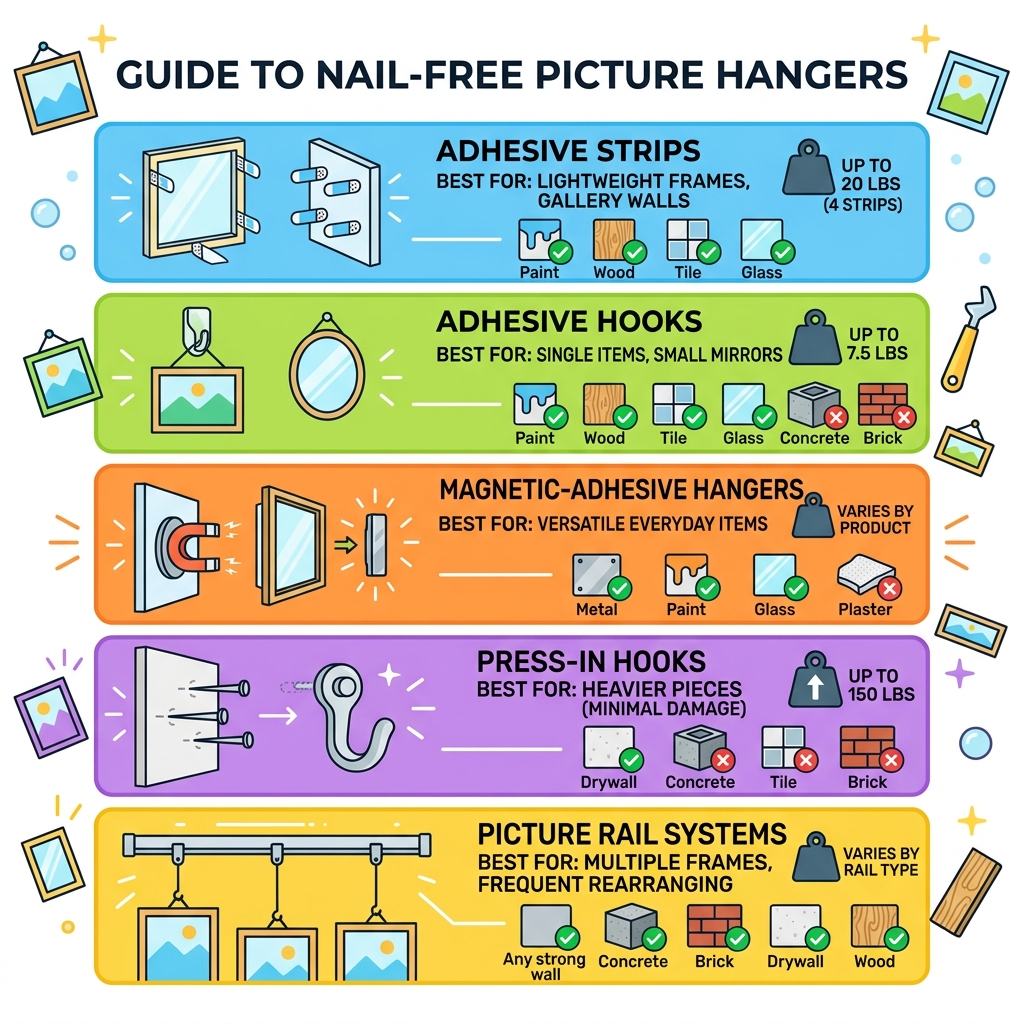
Here are the most common types at a glance:
| Method | Best For | Max Weight |
|---|---|---|
| Adhesive strips | Lightweight frames, gallery walls | Up to 20 lbs (4 strips) |
| Adhesive hooks | Single items, small mirrors | Up to 7.5 lbs |
| Picture rail systems | Multiple frames, frequent rearranging | Varies by rail type |
| Magnetic-adhesive hangers | Versatile everyday items | Varies by product |
| Press-in hooks | Heavier pieces, minimal damage | Up to 150 lbs |
| Leaning / easels | Large art, no wall contact needed | No weight limit |
If you rent your home, you know the frustration. You want your space to feel like yours — but one nail hole can cost you your security deposit. Even homeowners often want a cleaner, more flexible way to decorate without committing to permanent holes.
The good news? Nail-free hanging has come a long way. Today’s options range from simple adhesive strips you can grab at any hardware store, to advanced no-stud systems built for items weighing hundreds of pounds.
This guide covers everything — from quick weekend fixes to long-term solutions — so you can hang with confidence on almost any wall surface.
Top Methods for Using a Picture Hanger Without Nails
When we think about decorating, we often default to the old hammer-and-nail routine. But if you’ve ever lived in a modern apartment with concrete walls or a historic home with delicate plaster, you know that nails aren’t always your friend. Fortunately, the market for a picture hanger without nails has exploded with creative, reliable solutions.
Adhesive Strips and Hook-and-Loop Fasteners
The most popular “no-nail” solution is the adhesive strip. These work using a “click-to-lock” or hook-and-loop mechanism. One side sticks to the wall, the other to the frame, and they snap together. They are fantastic for gallery walls because you can easily adjust the position of the frame until it clicks into the perfect spot. Brands like Command and X-Protector have mastered this technology, offering different sizes for different weights.
Magnetic Hangers
For those who like to swap out art frequently, magnetic systems like KLAPiT are a game-changer. These use a combination of powerful magnets and high-strength adhesive. You stick one magnet to the wall and another to the object. The “klaping” sound tells you it’s secure. It’s perfect for items you might want to take down and use, like a remote control or a small whiteboard, or for rotating seasonal art.
Picture Rail Systems
If you live in an older home, you might already have a picture rail — a horizontal molding near the ceiling. If not, you can install a modern version like the STAS system. These systems use an aluminum rail and thin transparent cords or steel cables with hooks. You can slide the hooks horizontally and vertically without ever touching the wall again. It’s the professional gallery look brought right into your living room.
Leaning Art and Easels
Sometimes the best picture hanger without nails is no hanger at all! Leaning large frames against a wall on top of a dresser, mantel, or even the floor creates a relaxed, “art studio” vibe. For smaller pieces, tabletop easels can turn a simple photo into a focal point on a bookshelf. You can learn more about these versatile options in our guide on how to stop-nailing-and-start-sticking-with-these-picture-hooks.

How to Choose the Best Damage-Free Solution
Choosing the right picture hanger without nails isn’t just about what’s on sale. We need to consider the “Big Three”: weight, surface, and environment. If you ignore these, you might wake up to the sound of shattering glass in the middle of the night!
- Weight Capacity: Always weigh your art (with the frame and glass!) before buying hangers. Most strips support between 1 and 20 lbs.
- Surface Texture: Adhesives love smooth surfaces. If your walls have a heavy “orange peel” or “popcorn” texture, adhesive strips may struggle to create a full bond.
- Environment Humidity: Bathrooms and kitchens are tricky. Standard adhesives can weaken in high humidity. Look for water-resistant versions specifically designed for damp environments.
For a deeper dive into which products suit your specific room, check out these no-damage-wall-hooks-you-can-buy-right-now.
Selecting a Picture Hanger Without Nails for Heavy Items
Can you really hang heavy items without nails? Yes, but you have to be strategic. For items up to 20 lbs, using four pairs of large Damage Free Picture Hanging Strips by X-Protector (20 Pairs) is a reliable choice.
For truly heavy items — think 50 to 400 lbs — we look toward “No Stud” technology. Systems like the Hangman No Stud Hanger use tiny nails (okay, technically they are nails, but they are as thin as pins) that enter the wall at an angle, distributing the weight across the drywall rather than relying on a single point or a stud. While they leave a tiny pinhole, it’s much less destructive than a standard nail or screw. You can find more tips in our stop-the-drop-a-guide-to-adhesive-wall-hooks-for-heavy-items.
Surface Compatibility for Your Picture Hanger Without Nails
Not all walls are created equal. Here is a quick breakdown of where your picture hanger without nails will perform best:
- Painted Drywall: The “gold standard” for adhesive strips. Just make sure the paint has cured for at least 7 to 30 days.
- Finished Wood: Great for polished cabinets or shiplap. Adhesives stick well to smooth, varnished wood.
- Tile and Glass: Perfect for kitchens and bathrooms. Suction cups or specialized “bath” adhesive strips work best here.
- Metal and Plastic: Ideal for dorm rooms or office cubicles.
Avoid using adhesives on wallpaper, brick, or fabric-covered walls, as the bond won’t be secure or might peel the surface off. For more surface-specific advice, read how-to-use-adhesive-wall-hangers-without-ruining-your-paint.
Innovative No-Nail Technologies and Systems
The world of wall decor is evolving. We are no longer limited to just “sticky tape.” Some of the most exciting innovations involve magnetic-adhesive hybrids and adjustable mechanical systems.
For instance, the TAKKER Easy Stick is a UK-born innovation that allows you to hang items up to 1kg (about 2.2 lbs) using a unique adhesive hook that is incredibly easy to apply and remove. It’s a favorite for those who want a quick, “no-fuss” solution for lightweight frames and clocks.
If you’re looking for something that can handle a bit more “heft” without finding a stud, the Hangman Products No Stud Technology Hanging Solutions, TV Mount Hanger is a marvel of engineering. It uses a galvanized aircraft-grade aluminum bracket that can support mirrors and even TVs on simple drywall.
For those who love a clean, modern aesthetic, magnetic systems like KLAPiT are revolutionizing the space. Measuring just 1 square inch, these “21st-century screws” use the world’s strongest permanent magnets to hold everything from speakers to power strips. To explore more high-tech options, see the-best-ways-to-hang-decor-without-a-single-drill-hole.
Step-by-Step Guide to Damage-Free Installation and Removal
Most failures with a picture hanger without nails happen because of poor installation. It’s not just “peel and stick” — there is a bit of science involved!
The Perfect Installation
- Clean the Surface: This is the most skipped step. Use isopropyl (rubbing) alcohol to wipe the wall. Avoid household cleaners, which can leave a slippery residue.
- Apply and Press: Once the wall is dry, apply your strips. Press each strip firmly for at least 30 seconds. This activates the pressure-sensitive adhesive.
- The “Wait” Rule: Most adhesive products, including the Command™ Picture Hanging Kit | 3M United States, require a one-hour “cure” time. Apply the strips, remove the frame, and let the wall-side strips sit for an hour before hanging the weight.
- The Paint Rule: If you just painted your room, wait at least 7 days (some experts say 30!) before applying adhesives. Fresh paint is still “off-gassing” and isn’t strong enough to hold a hanger.
The Damage-Free Removal
To remove adhesive strips without taking the paint with them, you must use the “stretch-release” method.
- Never pull the strip toward you.
- Slowly pull the tab straight down, parallel to the wall.
- Keep pulling until the strip stretches (it can stretch up to 15 inches!) and eventually pops off the wall cleanly.
For more visual learners, we have a detailed walkthrough in our post on how to hang-your-masterpiece-top-adhesive-picture-hangers-heavy-duty-strength.
Adjusting and Reusing Your Hangers
One of the biggest headaches is hanging a picture only to realize it’s half an inch too low. The FrogTape reMOVEables™ Adjustable Picture Hanger solves this with an adjustable peg. You can slide the peg up or down even after it’s stuck to the wall.
Many of these systems are also reusable. While you’ll need a fresh adhesive strip, the plastic hooks and magnetic bases can be used for years. This makes them a sustainable choice for those who like to redecorate often. Check out these 10-stylish-ways-to-use-decorative-hooks-around-your-house for more inspiration.
Frequently Asked Questions about Nail-Free Hanging
Can you hang heavy mirrors without nails?
Yes, but you need to distribute the weight. For mirrors up to 20 lbs, multiple large adhesive strips can work. For mirrors over 20 lbs, we recommend “No Stud” cleats or picture rail systems. Always check the weight rating on the package and never exceed it. If a mirror is particularly valuable or hangs over a bed, we usually suggest a more permanent mechanical fastening for peace of mind.
Are adhesive strips safe for wallpaper?
Generally, no. Most manufacturers explicitly warn against using adhesive strips on wallpaper. The bond between the wallpaper and the wall is often weaker than the bond between the adhesive and the paper. When you try to remove the strip — or if the picture is too heavy — you’ll likely peel the wallpaper right off. For wallpapered walls, leaning art or using a ceiling-mounted picture rail is a much safer bet.
How do you remove hangers without peeling paint?
The secret is patience and the “downward pull.” If a strip feels stuck, you can use a hairdryer on a low setting to gently warm the adhesive for 30 seconds. This softens the bond, making it easier to stretch the strip away. Just be careful not to overheat the paint!
Conclusion
At Gostosuras Doces, we believe your home should reflect your personality, whether you own it or are just passing through for a year. Using a picture hanger without nails is the ultimate way to bridge the gap between “temporary living” and “feeling at home.”
By choosing the right method — whether it’s a high-tech magnetic KLAPiT system, a classic Command strip, or a professional-grade STAS rail — you can create the gallery wall of your dreams without a single “sorry” to your landlord. Remember to always weigh your items, clean your walls with alcohol, and pull down, not out, when it’s time for a change.
Ready to organize the rest of your space? Explore more home storage solutions on our blog!
