
Why Hanging a Shelf Without Brackets Is Easier Than You Think
Hanging a shelf without brackets gives you that clean, modern floating look — no bulky metal hardware, no cluttered wall, just a shelf that appears to float in mid-air.
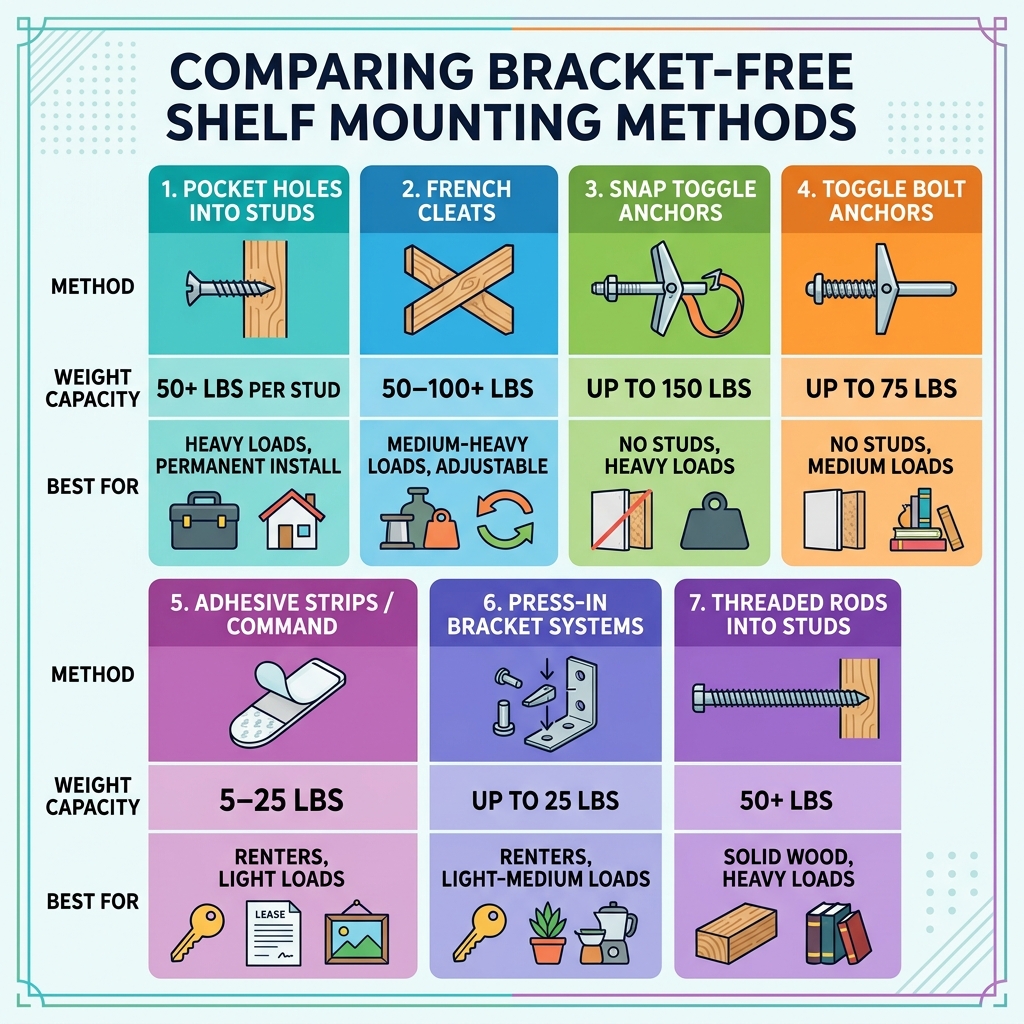
Here are the most popular bracket-free methods at a glance:
| Method | Best For | Weight Capacity |
|---|---|---|
| Pocket holes into studs | Heavy loads, permanent install | 50+ lbs per stud |
| French cleats | Medium-heavy loads, adjustable | 50–100+ lbs |
| Snap Toggle anchors | No studs, heavy loads | Up to 150 lbs |
| Toggle bolt anchors | No studs, medium loads | Up to 75 lbs |
| Adhesive strips / Command | Renters, light loads | 5–25 lbs |
| Press-in bracket systems | Renters, light-medium loads | Up to 25 bs |
| Threaded rods into studs | Solid wood, heavy loads | 50+ lbs |
Whether you rent your space, want zero wall damage, or just hate the look of visible hardware — there is a solution that fits your situation.
The frustrating part? Most guides assume you already know which method is right for your wall type and load. They don’t. This guide does.
Below, we break down every major bracket-free option, compare weight limits honestly, and walk you through the steps for each approach — so you can pick the right one and get it done with confidence.
Best Methods for Hanging a Shelf Without Brackets
Achieving a high-end, minimalist aesthetic doesn’t always require expensive floating shelf kits from a boutique store. In fact, some of the most secure ways to achieve this look involve clever woodworking techniques or industrial-strength hardware hidden completely from view.
When we talk about hanging a shelf without brackets, we are usually referring to “floating” the shelf. This means the support mechanism is either inside the shelf itself or tucked behind it so that once the shelf is mounted, the hardware is invisible to anyone standing in the room.

Hanging a Shelf Without Brackets Using French Cleats
The French cleat is a classic woodworking secret that we absolutely love for its simplicity and incredible strength. A French cleat consists of two interlocking strips of wood (or metal), each cut at a 45-degree angle. One strip is mounted to the wall with the angle facing up, and the other is attached to the back of the shelf with the angle facing down.
When you slide the shelf onto the wall strip, the two angles lock together. This method is excellent for weight distribution because the cleat typically spans the entire length of the shelf, allowing you to hit multiple studs. If you are looking for more ways to organize your home without traditional drilling, check out our practical wall storage ideas.
Pros of French Cleats:
- Extremely strong; can hold 50–100+ lbs depending on the material.
- Self-leveling once the wall piece is straight.
- Allows you to easily remove the shelf for cleaning or painting.
Cons:
- The cleat adds thickness to the back of the shelf, so you must design the shelf with a recessed back if you want it to sit perfectly flush against the wall.
Invisible Threaded Rods for Solid Wood
If you have a thick, solid wood slab—like a live-edge piece or a heavy 2×10—threaded rods are a professional-grade solution. This method involves drilling deep holes into the wall studs and matching holes into the back of the shelf.
You screw heavy-duty threaded rods (often 1/2-inch diameter) directly into the center of the wall studs. For maximum stability, experts recommend cutting the rods so that about 5 to 8 inches protrude from the wall. You then slide the shelf onto these rods. Because the rods are anchored deep into the wood framing of your home, they can handle significant torque and heavy items like stacks of books or kitchen glassware. This is often the preferred method for masonry walls where you can use lead anchors to hold the rods in place.
Heavy-Duty Hardware for Studless Walls
Sometimes, the perfect spot for a shelf isn’t anywhere near a wall stud. In older homes or modern apartments with awkward layouts, you might find yourself staring at a vast expanse of hollow drywall. Don’t worry—you can still achieve a bracket-free look.
The key is using high-performance hollow-wall anchors. Unlike standard plastic plugs that tend to pull out under the leverage of a floating shelf, these heavy-duty options grip the back of the drywall to create a “sandwich” effect.
| Anchor Type | Max Weight Capacity | Best Use Case |
|---|---|---|
| Snap Toggle | 150 lbs | Heavy kitchen shelves, small TVs |
| Toggle Bolt | 75 lbs | Medium decor, small book collections |
| Screw-in Anchor | 25-50 lbs | Light frames, bathroom toiletries |
Snap Toggles and Toggle Bolt Anchors
For those wondering how to hang a shelf without brackets when there are no studs available, Snap Toggles are the gold standard. A Snap Toggle features a solid metal channel that you slide through a pre-drilled hole. Once inside the wall, the channel flips flat against the interior surface. You then zip a plastic collar tight against the outside of the wall and snap off the excess straps.
This creates a permanent, threaded metal hole in your drywall that can support up to 150 lbs. Traditional toggle bolts work similarly but are a bit more finicky, as the “wings” must be attached to the bolt before you push them through the wall. These are perfect for heavy glassware or kitchen spices where failure is not an option.
Hanging a Shelf Without Brackets on Drywall
When working with gypsum plaster or drywall, precision is your best friend. Because drywall is essentially compressed dust between two sheets of paper, it can crumble if you use the wrong drill bit or an oversized pilot hole.
Always match your drill bit size exactly to the manufacturer’s recommendations for the anchor. If the hole is even a fraction too large, the anchor will wobble, eventually leading to a sagging shelf. For those who prefer to avoid the heavy hardware of toggle bolts, you might consider high-capacity adhesive options. Read our guide to adhesive hooks for heavy items to see how modern chemical bonds are changing the DIY game.
No-Drill Solutions for Renters and Light Loads
We know the struggle: you want the floating shelf look, but your landlord will keep your security deposit if they see a single drill hole. Or perhaps you’re working with a tiled surface in a bathroom where drilling is risky. In these cases, no-drill solutions are a lifesaver.
Adhesive Strips and Heavy-Duty Hooks
Modern adhesives have come a long way from the gummy tapes of the past. Professional-grade mounting tapes and heavy-duty utility hooks can now support surprising amounts of weight. For example, Command heavy-duty utility hooks can hold up to 15 pounds, which is plenty for a small floating ledge holding photos or light decor.
The secret to success with adhesives is surface preparation. You must clean the wall with rubbing alcohol to remove oils and dust. Furthermore, you must respect the “curing time.” Most high-strength adhesives require 24 to 72 hours of bonding time before you actually place weight on the shelf. If you’re looking for the best products on the market, browse our list of the top adhesive hooks for heavy items.
Tension Rods and Press-In Brackets
Another brilliant renter-friendly hack involves tension. In bathrooms or between two close walls (like a closet or a nook), tension rods can support a lightweight shelf without a single mark on the wall.
Alternatively, “press-in” bracket systems, such as High & Mighty shelves, use tiny steel pins that you push into the drywall with just your thumbs. These can hold up to 25 pounds and leave holes no larger than a pinprick, which are easily hidden with a tiny dab of toothpaste or spackle when you move out.
Step-by-Step Guide: Hanging a Shelf Without Brackets Using Pocket Holes
This is our favorite “pro” DIY method. It uses a Kreg jig to create angled “pocket holes” in a solid wood board, allowing you to screw the shelf directly into every wall stud it crosses. It is incredibly strong and uses zero visible hardware once the holes are plugged.
Tools and Materials Needed:
- Solid wood board (1.5″ to 2″ thick works best)
- Kreg Pocket-Hole Jig
- 2-inch or 2.5-inch Kreg screws
- Stud finder
- Level
- Painter’s tape
- Wood glue and pocket-hole plugs
- Orbital sander
The Process:
- Locate the Studs: Use your stud finder to locate every stud along the area where the shelf will go. Mark the center of each stud with a small piece of painter’s tape.
- Mark the Shelf: Hold your board up to the wall (use a helper!) and transfer the stud locations to the back edge of the board.
- Drill Pocket Holes: Use your Kreg jig to drill two pocket holes at every stud mark. Ensure the holes are on the top of the shelf if the shelf is above eye level, or the bottom if it’s high up, so they remain hidden.
- Prep the Surface: Use an orbital sander to smooth the board. This is the time to stain or paint your shelf.
- Mount the Shelf: Place your level on top of the board. Drive the Kreg screws through the pocket holes and directly into the wall studs. Because each stud connection can hold over 50 lbs, a shelf hitting three studs is incredibly secure.
- Plug the Holes: Apply a bit of wood glue to your pocket-hole plugs and tap them into the holes. Once dry, sand them flush and touch up the stain for a completely invisible finish.
Essential Tools and Safety Precautions
Before you start hanging a shelf without brackets, safety should be your top priority. Walls aren’t just empty space; they are home to electrical wires, plumbing lines, and gas pipes.
- Use a Cable Detector: Before drilling, use a multi-scanner that detects live AC wires and pipes. Hitting a water line will ruin your day; hitting a power line can be fatal.
- Check Weight Distribution: Always place heavier items (like large vases or stacks of books) directly over the points where the shelf is anchored to a stud.
- Level Twice, Drill Once: A shelf that is off by even a quarter-inch will be glaringly obvious once you put items on it. Use a long carpenter’s level for the best results.
- Consult a Pro: If you are dealing with a very heavy load (over 100 lbs) or a crumbling lath-and-plaster wall, it might be worth calling a professional handyman to ensure the installation is structurally sound.
Frequently Asked Questions about Hanging a Shelf Without Brackets
How much weight can a shelf hold without brackets?
It depends entirely on the method. A shelf screwed into studs using pocket holes or threaded rods can easily hold 50 lbs per stud (often 100–150 lbs total). However, adhesive-based “no-drill” shelves are usually limited to 5–15 lbs. Always check the rating of your specific anchors or tape.
Can I hang a heavy bookshelf on drywall without studs?
Yes, but you must use specialized hardware. Snap Toggles are the best choice here, as they can support up to 150 lbs in standard 1/2-inch drywall. Avoid using standard plastic expansion anchors for heavy shelves, as the “leverage” of the shelf will eventually pull them out of the wall.
Will adhesive strips damage my wall paint during removal?
If you use brand-name products like Command strips and follow the removal instructions (pulling the tab straight down slowly), they should leave zero residue or damage. However, if you “rip” them off or use construction-grade adhesive, you will likely take the paint and the top layer of drywall with it.
Conclusion
At Gostosuras Doces, we believe that home organization should be as beautiful as it is functional. Achieving a minimalist, clean aesthetic through hanging a shelf without brackets is a rewarding DIY project that can transform any room from cluttered to curated.
Whether you choose the brute strength of threaded rods, the clever engineering of French cleats, or the renter-friendly ease of heavy-duty adhesives, you now have the knowledge to do it right. Remember to always prioritize safety by checking for wall utilities and respecting weight limits.
Ready to take your home organization to the next level? Explore more storage solutions on our blog for more expert tips and DIY inspiration!
