
Why Smart Dorm Room Organization Ideas Can Make or Break Your First Semester
Dorm room organization ideas can transform even the smallest, most awkward living space into a calm, functional home base for studying, sleeping, and socializing.
Here are the top dorm room organization ideas to get started fast:
- Use vertical wall space with Command hooks, floating shelves, and over-the-door organizers
- Maximize under-bed storage with rolling bins, vacuum bags, and bed risers
- Create distinct zones for sleeping, studying, and relaxing — even in a tiny room
- Choose multi-functional furniture like storage ottomans and rolling carts
- Coordinate with your roommate early to avoid storage conflicts
- Use damage-free solutions like adhesive strips and tension rods to protect dorm walls
Dorm rooms are genuinely tiny. Most students are working with a space that needs to serve as a bedroom, office, lounge, closet, and kitchen all at once. That is a lot to ask of a few hundred square feet.
The good news? You don’t need a big space to stay organized. You just need a smart system.
Millions of students move into dorms every year facing the same core problem: too much stuff, not enough room. The students who thrive are not the ones with the most storage products — they are the ones who set up simple, repeatable systems from day one.
This guide breaks down exactly how to do that, room by room.

Essential Dorm Room Organization Ideas for Vertical Storage
When we talk about small-space living, the first rule we always share is: if you can’t go out, go up. Your floor space is a precious commodity, but your walls are usually wide open. Utilizing vertical space is the secret weapon of successful dorm room organization ideas.
One of the most effective ways to start is by using over-the-door organizers. These aren’t just for shoes! We’ve seen students use them to store everything from snacks and cleaning supplies to hair tools and charging cables. By keeping these small items off your desk and dresser, you immediately reduce the visual clutter in the room.
Floating bookshelves are another fantastic option. Instead of stacking books on your desk, you can display them vertically on the wall. This not only saves space but also adds a splash of personality and color to your room. To keep your walls pristine, we recommend using high-quality adhesive-backed shelves or “no-nail” solutions.
For smaller items like jewelry, keys, or even light jackets, Command hooks are non-negotiable. You can create a dedicated “landing zone” near your door for your backpack and keys so you never have to hunt for them before an 8:00 AM lecture. If you’re looking for more ways to optimize every inch, check out these tiny-apartment-hacks-how-to-organize-and-maximize-your-space for professional-level inspiration.
According to experts on How to create an organized, stylish dorm, vertical zoning helps visually separate your study and sleep areas, which is crucial for mental health in a shared room. Consider using magnetic strips for metal office supplies or adhesive wall pockets for your phone and remote right next to your bed.
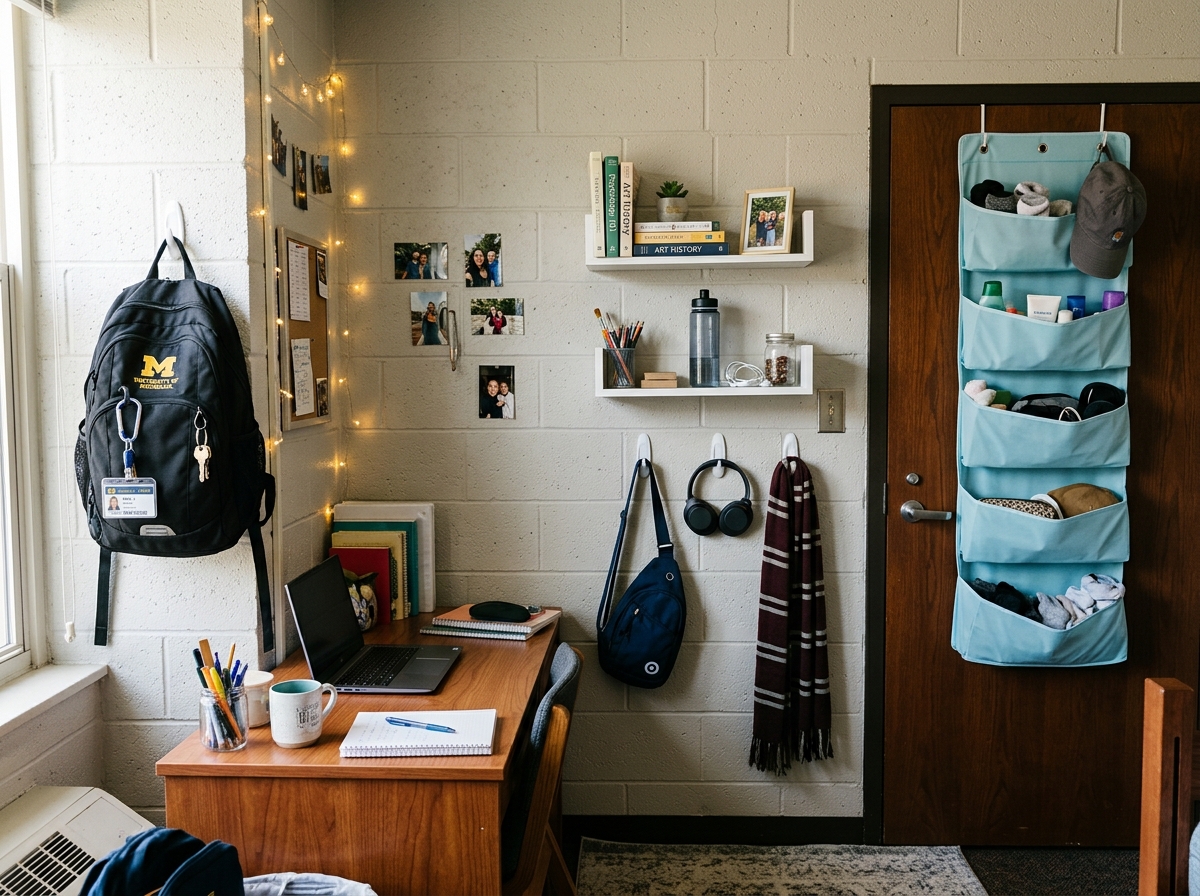
Maximizing Wall Space Without Damage
The biggest hurdle for most of us is the dreaded cinder block wall. These cold, hard surfaces are notoriously difficult to decorate or organize without violating housing contracts. However, we have a few clever workarounds.
Tension rods are a lifesaver for cinder block rooms. You can use them in window frames or between two walls to hang lightweight curtains. This “curtain wall” hack is brilliant because it hides the industrial look of the dorm and can even serve as a backdrop for a closet-organization-ideas-for-compact-living setup where you hide your storage bins behind a stylish fabric.
Pegboards are another favorite for vertical organization. If you can’t mount them directly to the wall, look for leaning pegboards or those that attach to the back of your desk. They allow you to customize your storage with hooks and baskets that can be moved as your needs change throughout the semester. By keeping your supplies visible but organized, you significantly reduce “visual noise,” which helps you focus during intense study sessions.
Mastering Under-Bed and Closet Solutions
The space under your bed is likely the largest unused area in your dorm. If your bed isn’t already lofted, we highly suggest using bed risers. Some modern risers even come with built-in power outlets, giving you extra charging ports right where you need them.
Once you’ve gained that extra foot of height, it’s time to choose your containers. We’ve put together a quick comparison to help you decide which dorm room organization ideas fit your lifestyle:
| Storage Type | Best For | Pros | Cons |
|---|---|---|---|
| Rolling Bins | Frequently used items (shoes, extra snacks) | Easy access, durable | Takes up more fixed space |
| Vacuum Bags | Seasonal clothes, extra bedding | Saves massive amounts of space | Requires a vacuum to reseal |
| Fabric Bins | Sweaters, towels | Breathable, looks nice | Can get dusty over time |
Lofted beds take this a step further by creating a “bonus zone.” You can fit a whole mini-fridge, a desk, or even a small loveseat under a fully lofted bed. For those staying in standard-height beds, look into under-bed-storage-solutions-for-small-apartments to find bins that slide smoothly on carpet or tile.
Don’t forget about shoe storage! Dorm closets are notoriously narrow. Instead of a pile of sneakers on the floor, use a specialized rack or over-the-door pockets. You can find more targeted advice on shoe-storage-solutions-for-cozy-apartments to keep your footwear organized and your room smelling fresh.
Smart Dorm Room Organization Ideas for Your Wardrobe
Closet space is usually the biggest point of contention in a shared dorm. To survive, we recommend adopting a capsule wardrobe. Bring only what you’ll actually wear for the current season and send the rest home or tuck it into vacuum bags.
Slimline hangers are a total game-changer—they can increase your hanging capacity by up to 50% because they are so much thinner than plastic or wood hangers. Combine these with cascading hooks (which allow you to hang multiple garments vertically on one hook) to maximize every inch of the closet rod.
Inside your drawers, use the “file folding” method. Instead of stacking shirts on top of each other, fold them into small rectangles and stand them up side-by-side. This way, you can see every shirt you own at a glance without digging through a messy pile. For more deep dives into closet efficiency, see our guides on closet-organization-ideas-for-compact-living-2 and closet-organization-ideas-for-compact-living-3.
Finally, implement a two-bag laundry system: one for lights and one for darks. If you use a backpack-style hamper, it makes the trek to the basement laundry room much easier!
Creating a High-Efficiency Study and Snack Zone
Your desk is where the magic (and the late-night cramming) happens. A cluttered desk leads to a cluttered mind, so we want to keep the surface as clear as possible.
A desk hutch or bookshelf is one of the best dorm room organization ideas for students with heavy textbooks. By moving your books and binders to a shelf above the desk, you free up the actual desktop for your laptop and notebook. If your dorm doesn’t provide one, you can buy adjustable desk shelving units that sit right on top of the furniture.
Cable management is another area where most students struggle. Between laptop chargers, phone cables, and desk lamps, the wires can quickly become a tangled mess. Use cable clips or even simple binder clips to keep your cords organized and prevent them from slipping behind the desk.
According to Teen Vogue’s guide on creating the best dorm study space, using acrylic bins to categorize your supplies (pens, highlighters, post-its) keeps everything visible but tidy. This prevents the “junk drawer” phenomenon that often plagues dorm desks.
When it comes to snacks, we recommend a dedicated mini-fridge station. You can buy or DIY a cart that holds your fridge on the bottom and has drawers for snacks, plates, and utensils on top. Using airtight containers for things like cereal or granola bars keeps them fresh longer and prevents pests—a common dorm reality! For more tips on boosting functionality in small zones, check out tiny-apartment-hacks-to-boost-space-and-functionality.
Desk-Specific Dorm Room Organization Ideas
To take your desk to the next level, consider a monitor stand. Not only is it better for your posture, but it also creates a “hidden” storage nook underneath for your keyboard or notebooks when you’re not using them.
Task lighting is also essential. A small LED desk lamp with a built-in USB port or a pencil cup saves space by combining two functions into one. We also love using school supply caddies—portable bins that you can grab and take to the library if you decide you need a change of scenery.
Digital organization is just as important as physical organization. We suggest setting up a “charging station” where all your devices live at night. This keeps your tech from cluttering your bed or floor. For layout inspiration that maximizes every square inch of your work area, explore studio-apartment-layout-ideas-for-maximum-efficiency and studio-apartment-layout-ideas-for-efficient-living.
Multi-Functional Furniture and Roommate Coordination
In a dorm, furniture should never do just one job. If it doesn’t have a storage compartment, we really have to ask if it’s worth the space!
Storage ottomans are a classic choice for a reason. They provide extra seating for friends, act as a step-stool to get into a lofted bed, and hide away bulky items like extra blankets or out-of-season shoes. Similarly, rolling utility carts (like the famous 3-tier metal versions) are incredibly versatile. You can use one as a nightstand, a makeup vanity, or a mobile coffee station.
When choosing furniture, look for pieces that are “dorm-sized.” A giant bean bag might look comfy, but it takes up a huge amount of floor space that could be used for something more functional. Instead, look for space-saving-furniture-solutions-for-small-apartments and multipurpose-furniture-ideas-for-compact-spaces that can be tucked away when not in use.
Coordination with your roommate is perhaps the most important “organization” tip we can offer. Before move-in day, send a quick text to decide who is bringing the big items. You don’t need two mini-fridges or two printers! Establishing shared space boundaries early prevents conflicts and ensures the room doesn’t feel like a storage unit for two people’s entire lives.
On move-in day, efficiency is key. We recommend removing all packaging at home so you aren’t dealing with piles of cardboard in a tiny room. Bring a basic tool kit (with a rubber mallet for adjusting bed heights!) and plenty of zip ties. For more ideas on how to pick the right pieces, read about how to maximize-your-space-with-multi-purpose-furniture-ideas.
Frequently Asked Questions about Dorm Organization
How do I organize a dorm room with no storage space?
If your dorm is an older building with zero built-in shelving, you have to create your own “walls” of storage. Use tall, skinny shelving units that have a small footprint but offer five or six levels of storage. Over-the-door racks on both sides of the door (one for shoes, one for towels) are essential.
You can also look into studio-apartments-unique-storage-solutions-that-work for ideas on using tension rods inside closets to add extra hanging levels. If there’s no closet, a sturdy rolling clothes rack can act as both a wardrobe and a room divider to create a sense of privacy.
What are the most common dorm organization mistakes to avoid?
The #1 mistake is over-packing. We promise you won’t need that third set of bed sheets or every single book you’ve ever owned. Another common pitfall is focusing only on aesthetics. That cute wicker basket might look great on Pinterest, but if it doesn’t fit under your bed or hold your textbooks, it’s just taking up space.
Ignoring your roommate’s needs is another big one. If you take up 75% of the wall space with your organizers, it’s going to lead to tension. Always communicate! For a list of what to leave behind, check out studio-apartments-unique-storage-solutions-that-work-2.
How can I maintain organization throughout the semester?
The best system in the world won’t work if you don’t use it. We recommend a “Weekly Reset.” Every Sunday, take 20 minutes to put everything back in its designated home, clear your desk, and do your laundry.
Follow the one-minute rule: if a task takes less than a minute (like hanging up your coat or putting a dish in the bin), do it immediately. Seasonal edits are also helpful; when the weather changes, swap out your clothes and send the old ones home to keep your closet from overflowing.
Conclusion
At Gostosuras Doces, we know that your dorm room is more than just a place to sleep—it’s the backdrop for your entire college experience. By implementing these dorm room organization ideas, you aren’t just cleaning up a room; you’re setting yourself up for academic success and significantly reducing your daily stress.
An organized space allows you to focus on what really matters: your studies, your new friendships, and discovering who you are. Start with the basics—vertical storage, under-bed bins, and multi-functional furniture—and adjust your system as you learn what works for you.
Ready to dive deeper into making your small space feel like a palace? Explore more small space ideas on our blog and turn that tiny dorm into the ultimate college sanctuary!
