
Why Adhesive Hooks for Pictures Are a Game-Changer for Renters and Homeowners
Adhesive hooks for pictures let you hang frames, art, and décor on your walls without drilling a single hole.
Here are the best options to consider, based on weight capacity and use case:
| Product | Best For | Weight Capacity |
|---|---|---|
| Command Large Picture Hanging Strips | Everyday frames and gallery walls | Up to 16 lbs (4 pairs) |
| Command 20 lb XL Heavyweight Hangers | Large or heavy frames | Up to 20 lbs |
| STAS Self-Adhesive Hangers | Acrylic prints, dibond, mirrors | Up to 22 lbs |
| ALFTA Adhesive Hook (IKEA) | Lightweight frames | Up to 4 lbs |
| tesa Powerstrips Picture Hook | Light pictures and calendars | Up to ~2.2 lbs (1 kg) |
| STAS Sawtooth Self-Adhesive Hook | Mounted photos and posters | Up to 3 lbs per hanger |
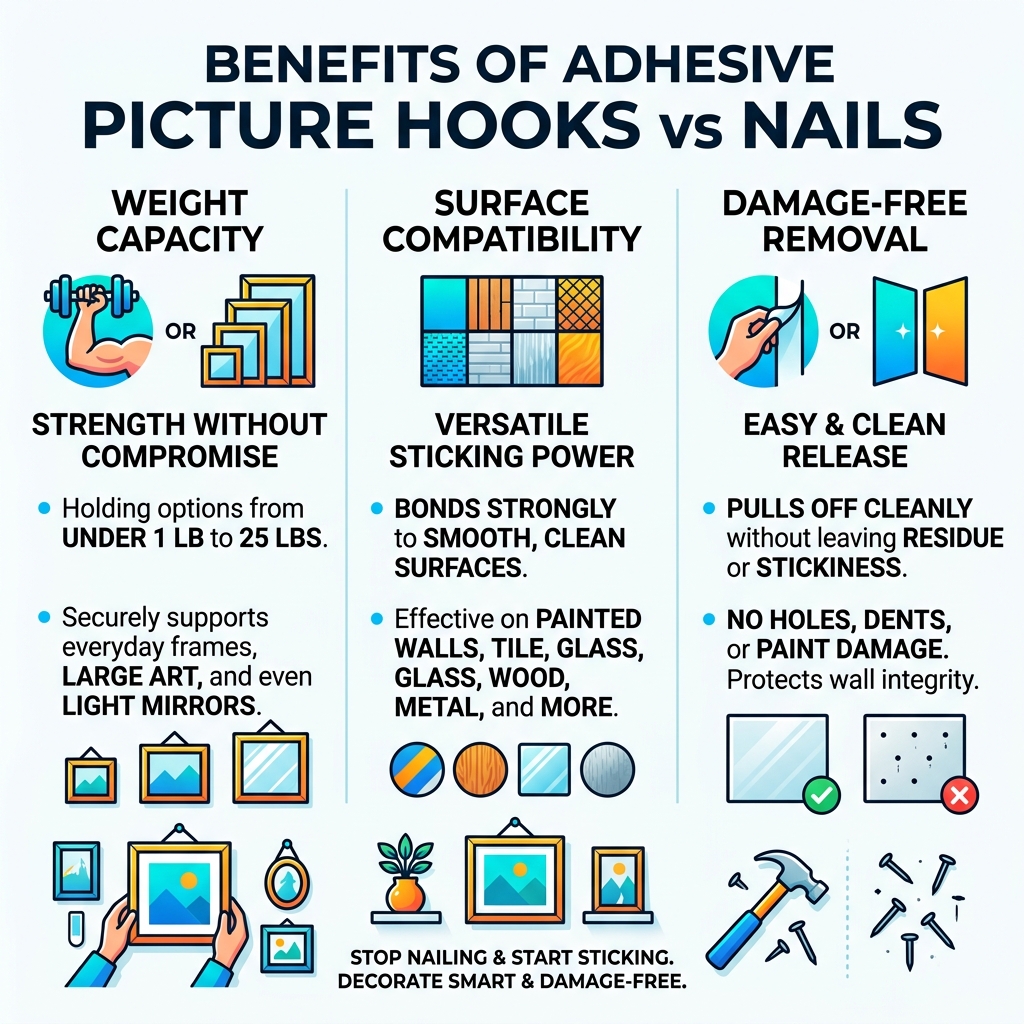
Nails leave holes. Screws need tools. And if you rent, damage to walls can cost you your deposit.
Adhesive picture hooks solve all of that. They stick firmly to smooth surfaces, hold your frames securely, and come off cleanly when you’re ready to move or redecorate. No tools. No mess. No stress.
The market has grown a lot. You can now find options that hold anywhere from under 1 pound all the way up to 25 pounds — enough for large framed art or even mirrors.
But not all adhesive hooks are equal. The wrong one can let your frame crash to the floor — or worse, peel your paint off the wall when you remove it.
This guide cuts through the noise. We’ll compare the top products, explain what works where, and help you pick the right hook for your situation.
Understanding Adhesive Hooks for Pictures and How They Work
To the untrained eye, an adhesive hook looks like a simple piece of plastic with some double-sided tape. In reality, modern adhesive hooks for pictures are feats of chemical engineering. They rely on advanced bonding technologies designed to balance two opposing forces: holding a heavy weight indefinitely and releasing that same grip without taking the wall with it.
The Science of the Snap and Stretch
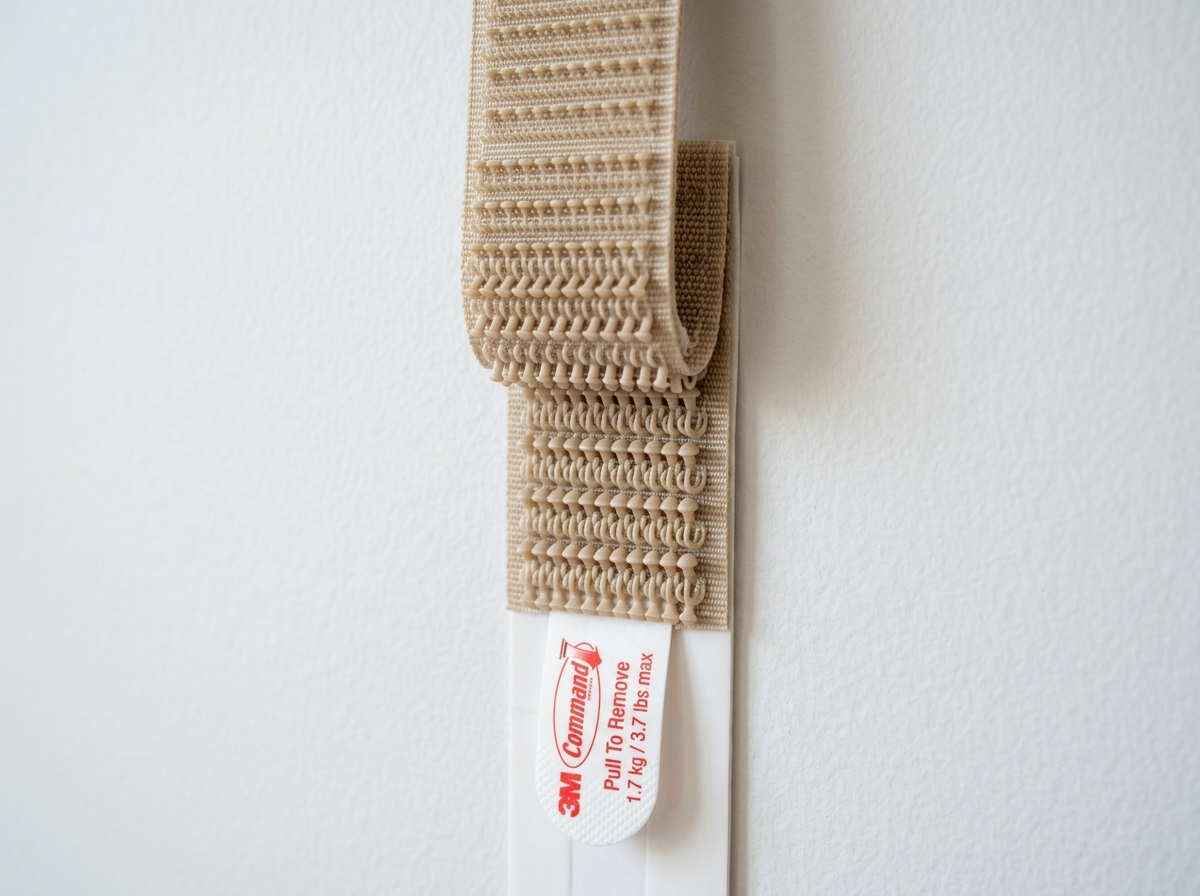
The most popular variety, the interlocking fastener, works similarly to industrial-strength hook-and-loop systems. Brands like 3M utilize a “click” system where two strips lock together. One side stays on the wall, and the other stays on the frame. This allows you to literally “snap” your art into place.
The magic, however, is in the stretch-release adhesive. These strips are pressure-sensitive. When you press them against the wall, the adhesive molecules flow into the microscopic valleys of the surface, creating a tight bond. When it’s time to go, pulling the tab stretches the adhesive strip. This stretching thins the material, breaking those microscopic bonds one by one until the strip simply lets go—leaving no residue behind.
Different Hooks for Different Frames
Not every piece of art has a flat back, which is why there are several types of 3M adhesive hanging technology and hardware styles:
- Interlocking Strips: Best for flat-backed frames. They keep the art flush against the wall.
- Sawtooth Hangers: These feature a plastic hook designed specifically to catch the “teeth” on the back of many standard frames.
- Wire-Backed Hooks: These have a deeper “throat” to accommodate the slack of a hanging wire.
- Foam-Backed Plates: Often used for professional displays like Dibond or acrylic panels, these use high-density foam adhesive to bridge small gaps on slightly uneven backs.
Selecting the Best Hanger Based on Weight and Surface
Choosing the right adhesive hooks for pictures isn’t just about the look; it’s a math problem. If your frame weighs 10 pounds and you use a hook rated for 5, gravity will eventually win—usually at 3:00 AM.
Weight Limits and Heavy-Duty Adhesive Hooks for Pictures
We often hear the myth that adhesives are only for posters. That’s no longer true. Modern heavy-duty options have pushed the boundaries of what “sticky” can do.
For example, a standard set of four pairs of large hanging strips can hold up to 16 pounds, which is plenty for a 24×36 inch frame. If you need more muscle, the 20lb XL heavyweight hangers are designed for substantial gallery pieces.
For the ultimate in heavy lifting, we look at STAS heavy-duty hangers. These professional-grade self-adhesive plates can support up to 22 lbs (10 kg) when applied to non-porous surfaces like aluminum or acrylic.
If you’re dealing with drywall and want to avoid the “sticky” route entirely while remaining tool-free, the 3M CLAW technology is a fantastic hybrid. It uses hardened steel claws that you simply push into the drywall with your thumbs. While technically not an “adhesive,” it fits the “no-tools” lifestyle and boasts impressive ratings of 25 lbs, 45 lbs, or even 65 lbs.
Surface Compatibility: Where to Stick and What to Avoid
The surface you are sticking to is just as important as the hook itself. Adhesives need a clean, smooth, and stable surface to work their magic.
The “Green Light” Surfaces:
- Painted Drywall: The most common surface. Ensure the paint is a standard matte, eggshell, or satin finish.
- Finished Wood: Stained or varnished wood works well.
- Glass and Metal: These are excellent because they are non-porous.
- Tile: Perfect for bathrooms or kitchens (though you should look for “water-resistant” strips for high-humidity areas).
The “Red Light” Surfaces (Avoid These!):
- Wallpaper: The adhesive is often stronger than the wallpaper’s bond to the wall. You won’t damage the hook, but you might peel the wallpaper right off.
- Brick and Cinder Block: These are too porous and textured for the adhesive to get a full grip.
- Textured Plaster: Think “popcorn” walls or heavy trowel patterns. The air gaps prevent a secure bond.
- Fresh Paint: This is a big one. You must wait at least 7 days for new paint to fully cure before applying adhesive hooks for pictures. If the paint is still “outgassing,” the hook will fall off, taking a chunk of fresh paint with it.
Temperature Matters: Most adhesives perform best between 50°F and 105°F (10°C to 40°C). If you’re decorating an unheated sunroom in the winter or a shed in the blistering summer, the bond may fail.
Proper Application and Removal Techniques
We’ve all been there: you’re excited to see the art on the wall, so you slap the hook on and hang the frame immediately. This is the number one reason for failure. Success with adhesive hooks for pictures requires a little bit of patience.
The Step-by-Step Success Method
- Prep the Surface: Forget the household cleaners; they often leave a slippery residue. Use rubbing alcohol (isopropyl alcohol) to wipe the spot. This removes oils from your hands and dust from the air.
- Apply and Press: Once the alcohol is dry, apply the strip to the hook (or the wall). Press firmly along the entire length for 30 seconds. Pressure activates the bond.
- The “Wait” Period: This is the hardest part. For standard strips, wait 60 minutes before hanging the frame. For professional-grade plates like STAS, a 24 to 72-hour curing period is recommended for maximum strength.
- Check Your Work: Give the hook a gentle tug before trusting it with your precious memories.
The Art of Damage-Free Removal
When it’s time to move, do not pull the hook away from the wall. This is a guaranteed way to rip the drywall paper.
Instead, use the pull-straight-down method. Hold the hook gently in place with one hand (to prevent it from snapping up and hitting you) and use the other hand to pull the tab slowly, straight down toward the floor. You may need to stretch the strip up to 15 inches before it finally releases.
The Dental Floss Trick: If a tab breaks or you’re dealing with a stubborn foam-backed hanger, don’t reach for a screwdriver. Take a piece of dental floss or thin fishing line. Slide it behind the hanger and use a “sawing” motion to cut through the foam adhesive. It’s a gentle way to remove the bulk of the hanger, after which you can rub away the remaining residue with your thumb.
For more creative ways to organize your space without a drill, check out our guide on practical wall storage ideas that don’t require drilling.
Professional-Grade Adhesive Hooks for Pictures
If you are looking for something a bit more specialized than what you find at the local grocery store, there are several professional options:
- tesa Powerstrips technology: These are incredibly popular in Europe and are known for their high-quality “reusable” hook bodies. You keep the plastic hook and just buy replacement strips, making it a more eco-friendly and cost-effective long-term solution.
- STAS Sawtooth Hooks: These are perfect for those who use professional photo labs. Many labs will actually install these on the back of mounted photos for you.
- ALFTA Frame Hooks: A favorite for those who want a simple, budget-friendly hook that holds up to 4 lbs. They are designed for quick gallery wall setups where the art is light.
Frequently Asked Questions about Adhesive Picture Hangers
Can adhesive hooks be reused or repositioned?
The plastic hook or the “hard” part of the hanger is almost always reusable. However, the adhesive strip itself is a one-time-use item. Once you’ve stretched it to remove it, the chemical bond is broken. If you want to move a picture, you’ll need a fresh adhesive strip. The exception is the “interlocking” style; you can take the picture off the wall to clean it or swap it with another frame of the same size, as long as the strips stay stuck to the wall and the frame.
How do I remove adhesive hooks without peeling paint?
The secret is the “slow stretch.” If you pull the tab toward you (away from the wall), you will peel the paint. You must pull the tab parallel to the wall. If the strip breaks, use the dental floss trick mentioned above. Also, ensure the paint was fully cured (at least 7 days old) before the hook was applied.
Are adhesive hooks safe for heavy mirrors or large art?
Yes, but only if you stay within the weight limits. For heavy mirrors, we recommend using multiple hooks or strips to distribute the weight. For example, if a mirror weighs 20 lbs, using two 15-lb rated hangers provides a safety buffer. However, for extremely valuable or fragile heirlooms, many experts still suggest a mechanical fastener (like a stud-mounted screw) just for peace of mind.
Conclusion
At Gostosuras Doces, we believe that your home should be a reflection of your personality, regardless of whether you own the walls or are just visiting for a while. Adhesive hooks for pictures have truly revolutionized home décor, making it possible to create a stunning gallery wall on a Tuesday and change it all by Friday without leaving a trace.
By choosing the right weight capacity, preparing your surfaces with care, and following the proper removal techniques, you can enjoy a damage-free, beautiful home. Ready to transform your living area? Discover more small space decoration ideas on our blog and start sticking your way to a better home today!
